Lucrezia Piovano, Art Research & Client Success
All Eyes On Paris
With a Modigliani valued at more than $100 million still looking for a buyer, and major works by Richter, de Kooning and Mehretu already sold, Paris Art Week is shaping up to be a revealing moment for the art market. Two landmark Impressionist collections are also set to go under the hammer.
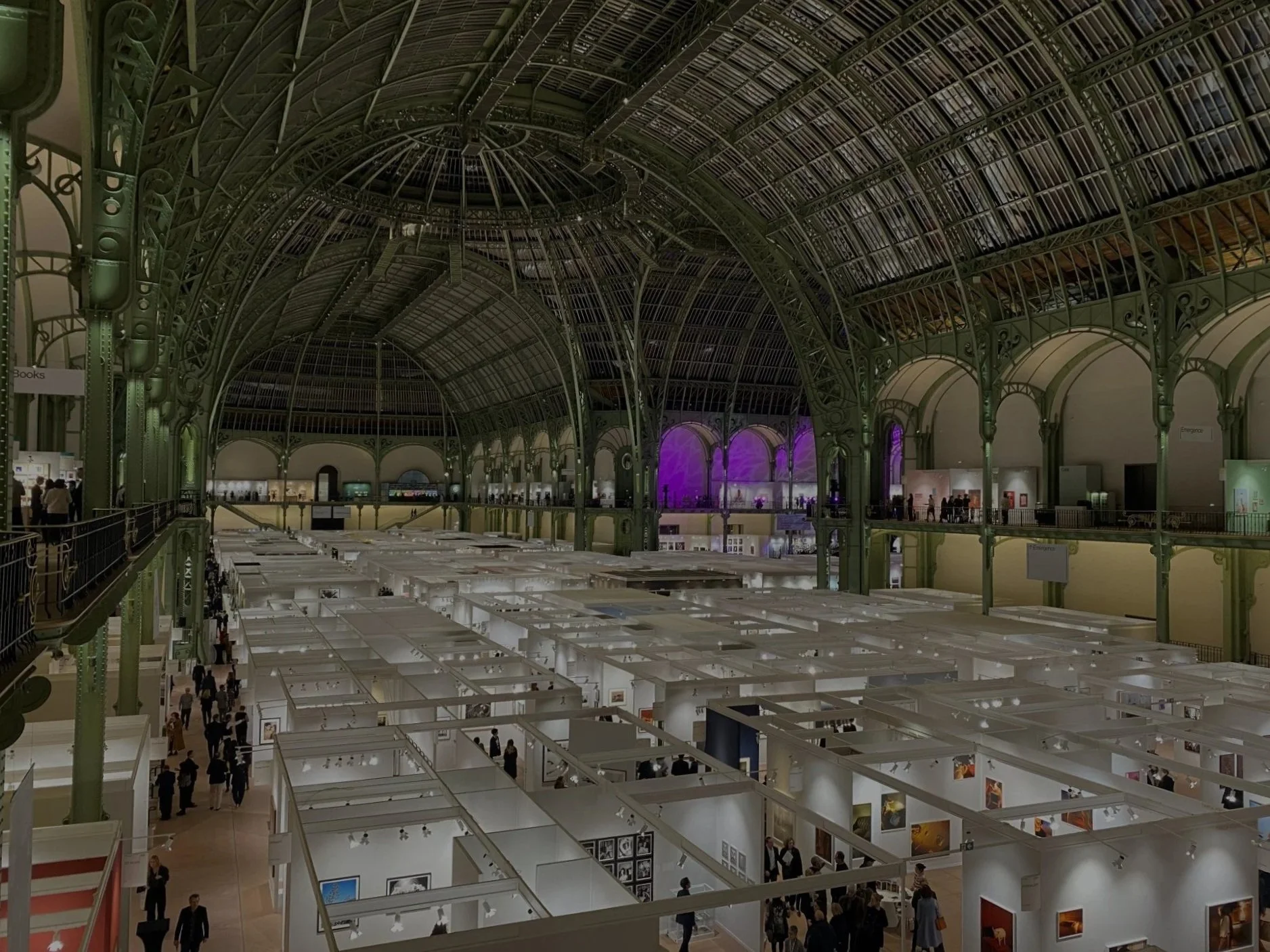
On Tuesday afternoon, beneath the glass vault of the Grand Palais, Hauser & Wirth sold Gerhard Richter’s Rokokotisch (Rococo Table) (1965) for around $10 million, alongside a Georg Baselitz painting, Der Hirte (The Shepherd) (1965), in the same price range. Both transactions took place during Art Basel Paris’s invitation-only Avant-Première, ahead of the fair’s public opening. The two sales were among the early highlights of the fair’s 5th edition, the first under the direction of Karim Crippa.
Early results point to a market in reasonable health, albeit without the buying frenzy seen in previous years. The bigger test will come on Thursday, when Sotheby’s and Christie’s bring two major Impressionist collections to auction, with combined estimates exceeding €70 million. The fair opens to the public on Friday.
Who Has Sold What?
The first transactions, announced by galleries during Tuesday afternoon's Avant-Première, offer an early indication of the mood. White Cube reported 16 sales, including two paintings by Julie Mehretu, dating from 2001 and 2018, each sold for $7.85 million.
Beyond the Richter and the Baselitz, Hauser & Wirth’s other sales included a 2026 George Condo for $2.9 million, a 1961 Concetto spaziale by Lucio Fontana for €1.7 million, a 1969 Philip Guston for $1.5 million, and an early-1950s Alexander Calder for just under $1 million.
Gagosian reported an eight-figure sale of a Willem de Kooning and the sale of a 2019 Peter Doig at an undisclosed price. By early afternoon, Thaddaeus Ropac had reported 15 sales.
Van de Weghe is offering, among other works, Joan Mitchell’s River III for $14.5 million and a 1982 Basquiat for $11 million. Gagosian is also showing a three-metre bronze by Jeff Koons, Corks (Couple), priced at approximately $4.5 million.
“We’re doing very well, but it was expected, to be honest,” said Ropac. “We’re off to a great start, we’re at home,” added Mathieu Templon. Emmanuel Di Donna likened the pace of sales to “drinking from a fire hose”.
Yet enthusiasm has its limits. “It’s definitely a slower pace than about five years ago, but great things do find great homes,” observed Marc Payot, president of Hauser & Wirth.
According to ARTnews, most galleries reported one or two sales, fewer than might typically be expected during the opening days of a major art fair. While much has been written about the London-versus-Paris debate, collector Will Paley, who divides his time between New York and São Paulo, described the two fairs as “complementary”, adding: “Frieze is primarily for young galleries, young artists, and young collectors with a more adventurous tone [while] Art Basel Paris has a higher price point.”
The picture is more nuanced than a straightforward return to exuberance. Buyers are still willing to commit substantial sums, but the market’s strength appears increasingly dependent on the quality of individual works.
The $100 Million Modigliani Still Seeking a Buyer
The work attracting the greatest attention, however, has yet to sell.
On a stand shared by Pace, Di Donna and Schrader hangs Nu étendu (Lolotte), a reclining nude painted by Amedeo Modigliani in 1917 and offered for more than $100 million.
That same year, the painting was exhibited at Galerie Berthe Weill in what was Modigliani’s only solo exhibition during his lifetime. The show was shut down by the authorities just hours after opening, following a scandal over the visibility of the nudes from the gallery window.
Acquired in 1920, the painting has remained in the same family ever since.
The asking price can be viewed in the context of the artist’s auction record. In 2015, Christie’s sold Nu couché for $170.4 million; in 2018, Sotheby’s achieved $157.2 million for Nu couché (sur le côté gauche).
There is, however, a notable qualification: the present work does not appear in Ambrogio Ceroni’s authoritative catalogue of Modigliani’s paintings, a key reference for the artist’s oeuvre. Its absence may make prospective buyers more cautious, even though the work’s quality and authenticity have not, according to the information available, been called into question.
Karim Crippa At The Helm
Crippa, who has spent eight years at Art Basel and previously served as communications director for its Paris edition, took over as fair director last November.
“The main change I see is a shift in pace, especially among collectors,” he explained. Buyers want more time to make decisions and speak to galleries. Introduced in 2025, the invitation-only Avant-Première gives galleries the opportunity to welcome their closest clients for an early viewing ahead of the fair’s main VIP opening.
This year’s edition brings together 211 galleries from 41 countries and territories, 64 of them based in France, with nearly 30 participating in the Paris fair for the first time.
First-time participants include Isabella Bortolozzi, ChertLüdde and Reena Spaulings Fine Art. Among the galleries absent this year are Lia Rumma and Balice Hertling.
On the balconies overlooking the Grand Palais’s central nave, the Emergence sector brings together 16 stands devoted to emerging artists. Among the participants is Carlos/Ishikawa, presenting South Korean painter Moka Lee in France for the first time.
On Friday and Saturday, participating galleries will also present new works on their stands as part of Oh La La!, a programme curated by Philippine Leroy-Beaulieu.
Beyond the fair, three bronzes by Tracey Emin are on view at the Parvis des Droits de l’Homme at the Trocadéro. At the Palais d’Iéna, filmmaker Alice Diop makes her exhibition debut in a project organised in collaboration with Miu Miu.
Thursday's Auction Test
Thursday 22 October will see two major Impressionist collections come to auction, with Claude Monet at the centre of both sales.
At 6pm, Sotheby’s will offer the collection of Jeanne Schlumberger. In 1958, Schlumberger helped the dealer Katia Granoff acquire works that had remained in the studio of Michel Monet, the artist’s son.
The leading lot is Iris (1924–25), measuring approximately 160 x 180 cm. It is the largest painting from the series ever to come to auction and, until now, has been known only through black-and-white photographs.
Its estimate of €22–30 million is the highest ever placed on a painting at auction in France, and the work could go on to set a new French auction record for a painting. Monet’s own record in France stands at €10.2 million, achieved at Sotheby’s in April.
The Schlumberger collection as a whole carries an estimate of more than €40 million.
At 2.30pm, Christie’s will present another major Impressionist collection, with a name central to the movement’s commercial history: Durand-Ruel.
Over several decades, the dealer Paul Durand-Ruel acquired works by Monet, Renoir, Pissarro and Sisley, at times providing artists with a regular income when demand for their work was limited. His heirs are now bringing 62 works to auction. The group has remained in the family for more than a century and has never previously been offered at auction.
The collection carries a combined estimate of €30–43 million. Its leading lot is Monet’s Bord des falaises à Pourville (1882), estimated at €11–15 million.
With two historic collections coming to market on the same day, Monet will be a key figure in Thursday’s auctions. The results should offer a useful indication of demand for major Impressionist works.
The Rest of The Auction Week
Thursday’s auction calendar also includes Christie’s 20th/21st Century Paris Evening Sale. The sale comprises 84 lots, including a selection of 25 Italian works marking the 25th anniversary of Thinking Italian, the auction house's annual celebration of 20th-century Italian art.
Among the leading lots is Lucio Fontana’s Concetto spaziale, Mezzogiorno in Piazza S. Marco (1961), from his Venetian series, estimated at €5.5–7.5 million. It is followed by an untitled work by Joan Mitchell and Amedeo Modigliani’s Minoutcha (1916–17), each estimated at €5–7 million, while Jeff Koons’s Ode to Love carries an estimate of €2.5–3.5 million. Michelangelo Pistoletto’s Migrante is being offered with an estimate available upon request.
On Friday, Sotheby’s turns to modern and Surrealist art. In Modernités, František Kupka’s Espace non-descriptif leads the sale with an estimate of €6–8 million. In Surrealism and Its Legacy, René Magritte’s Morceaux choisis (1950) carries the highest estimate, at $5.6–7.9 million, followed by a work by Joan Miró.
The week concludes on Saturday at Artcurial, where a Breton painting by Paul Gauguin, dating from 1889, is estimated at €2.2–2.8 million.
Together, these sales span a broad range of the market, from Italian modernism and post-war abstraction to Surrealism. Their results should help indicate whether demand remains concentrated on a handful of high-profile works or extends across a wider range of artists and movements.
Beyond The Grand Palais
Beyond the main fair, Paris’s satellite events are drawing collectors and visitors across the city.
Paris Internationale moves to a new venue on the Canal Saint-Martin, bringing together around 60 galleries. Asia Now takes place at the Monnaie de Paris, while Design Miami occupies the Hôtel de Maisons. From Thursday, Moderne Art Fair will be installed on Place de la Concorde, while Post-Fair, founded in Los Angeles, makes its European debut in the Marais.
The wider cultural programme adds another dimension to the week. On Saturday, Large, Laurent Dumas’s new art centre on the Île Seguin, opened with an exhibition curated by Cecilia Alemani. Alongside the satellite fairs, exhibitions and installations across the city extend the programme well beyond the Grand Palais.
What to Watch
The question is whether Paris's wider cultural offering will ultimately strengthen the fair or distract from it.
As the Italian art newspaper Il Giornale dell’Arte has observed, the sheer number of exhibitions and events across the city could paradoxically work against the fair, dispersing attention among too many competing attractions. Thaddaeus Ropac, however, sees this competition as a factor that encourages collectors to make decisions quickly.
This tension points to a defining feature of Art Basel Paris: its success cannot be measured by sales alone. The fair is part of a wider cultural and commercial ecosystem in which galleries, museums, auction houses and satellite fairs all seek to attract the same international audience.
On Thursday, Monet’s Iris will have the chance to set a new auction record in France. In the days that follow, the market will also reveal whether the Modigliani finds a buyer. Together, these outcomes will offer two different measures of demand for major works at the highest end of the market.
All eyes on Paris.