
Lucrezia Piovano, Art Research & Client Success
New York’s $2.4 Billion Week: Rarity Rewarded, Overconfidence Punished
New York’s November auctions brought in about $2.44 billion, up on a year ago, led by a record $190.4 million Van Gogh, sold after its owners reached a last-minute settlement with the heirs of its former Jewish owners.
Beneath the headline numbers, however, the week revealed a market that pays for rarity and sensible estimates and has little patience for anything else. With demand intact but estimates running ahead of it, pricing, not appetite, is now the market’s main risk.
The numbers
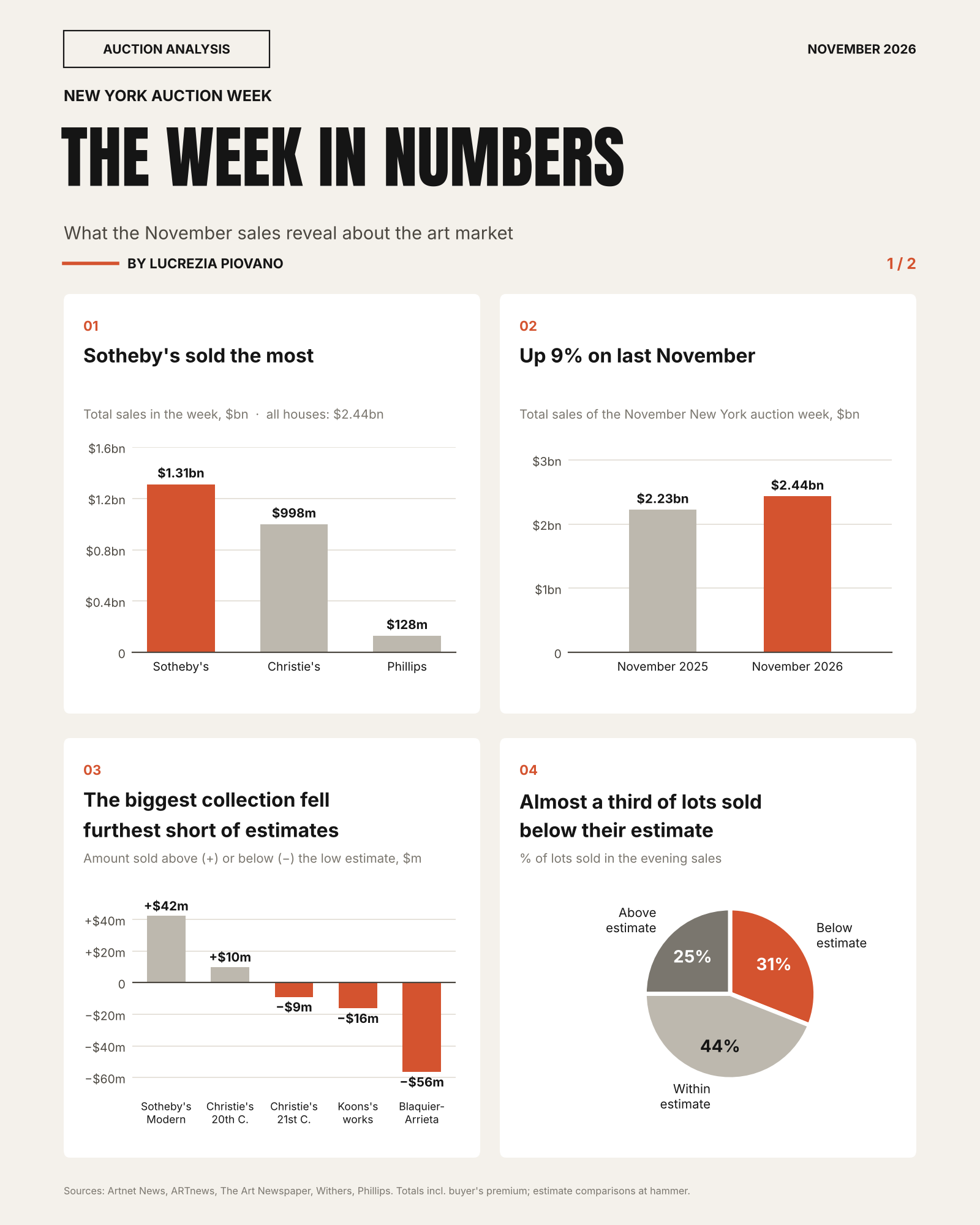
Across Christie’s, Sotheby’s and Phillips, evening and day sales together totalled about $2.44 billion, compared with $2.23 billion in November 2025. [1] The evening sales alone made $2.03 billion, against a combined low estimate of $1.7 billion. That comparison flatters the result, however, since sale totals include the buyer’s premium while estimates do not.
Sotheby’s led the week with around $1.31 billion, ahead of Christie’s at about $998 million and Phillips at about $128 million. On the eve of the sales, the auction houses had expected between $2.04 and $2.4 billion, a forecast that also included Bonhams.[2]
Measured at hammer prices, the picture is less flattering: the four main Modern and Contemporary evening sales – Christie’s 20th and 21st Century, Sotheby’s The Now & Contemporary and Phillips – made about $949 million and finished around 3% below their combined low estimate.
Bonhams had a quieter week: its 20th- and 21st-century evening sale made $10 million, and a single-owner sale of five Constantin Brâncuși bronzes realised about $15.1 million.[3] The bronzes had been expected to fetch around $25 million, and every bronze with a published estimate sold below it.
Comparison with last year and with May
The week grew by about 9% on November 2025. Some of that growth came from easy comparisons: Sotheby’s contemporary sale a year ago followed the $527.5 million Lauder collection, and Phillips’ 55% increase rested largely on a single lot.[4]
In May, the three houses had taken in more than $2.5 billion in New York, roughly double May 2025, so November came in slightly lower. The bigger difference is the depth of bidding: the Van Gogh sold after a few minutes of bidding and Cézanne’s Arlequin found only one bidder. Last month in Paris, by contrast, Sotheby’s took 45 minutes to sell Monet’s Iris.
Sale by sale
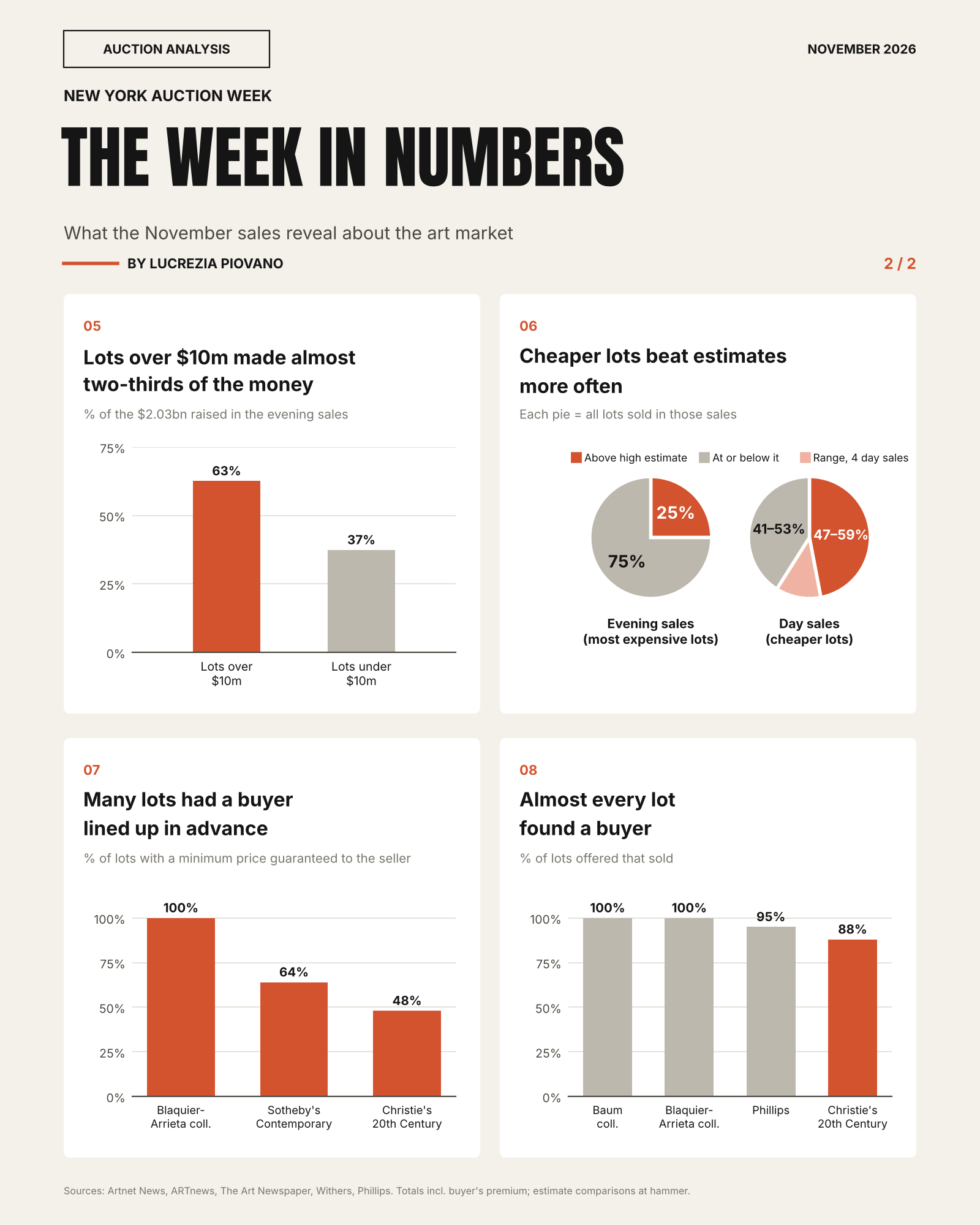
Sotheby’s opened the week on 16 November with $378.7 million from two sales. The Theodore and Ruth Baum collection sold all 24 lots for $109.9 million, although a third of them hammered below their low estimates. Its top lot, Joan Mitchell’s Green Book of Barbara Guest, made $19.3 million, almost 300 times the $65,000 the Baums paid for it in 1986.
In The Now and Contemporary sale, Yayoi Kusama’s No. 3P.B. (1960) set a record of $15.1 million for the artist, who died in August. Guarantees covered 29 of the 45 lots sold, yet guarantors were often outbid. “The best works always do fine, [but] buyers were taking some risks again,” observed the adviser Ed Dolman.[5]
On the morning of 17 November, Sotheby’s held two day sales: its Contemporary Day Auction, which made $83.03 million from 191 works, and the day session of the Baum collection.
That afternoon, Phillips sold 21 of its 22 lots for $104.4 million, led by Amedeo Modigliani’s limestone Tête (1911–12) at $44.6 million, against an estimate of $28–35 million. Without the Modigliani, the sale would have made $59.8 million, less than the $67.3 million Phillips achieved a year earlier.
In the evening, Christie’s 20th Century sale made $626.6 million, or $521 million at hammer, at the low end of its $511–743 million estimates. Wassily Kandinsky’s Betonte Ecken (1922–23) set a record at $85.8 million, almost doubling the artist’s previous high, and Gustav Klimt’s Litzlbergkeller (1915–16) followed at $82.3 million. Yet more than a third of the lots had to be sold below their low estimate.
On 18 November, Christie’s held its Impressionist and Modern Art Day Sale, which made $65.74 million, above its high estimate, and its Impressionist and Modern Works on Paper sale, which made $14 million.
That evening, Sotheby’s took $777.8 million across two back-to-back sales, its highest total for a single evening. Vincent van Gogh's Châtaigniers en fleurs (1890), from the Blaquier-Arrieta collection, sold for $190.4 million to the dealer William Acquavella, a record for the artist and the fourth-highest price ever achieved at auction for a work of art.[6] Its hammer price of $165 million, however, fell short of the estimate of around $180 million. The various-owner Modern Evening sale that followed was livelier, making $365.8 million, led by Edward Hopper’s The Martha McKeen of Wellfleet (1944), sold for $47.8 million. The painting came from the collection of Baroness Carmen Thyssen-Bornemisza and had been in the family since 1980.
On 19 November, Sotheby’s Modern Day Auction made $58.66 million, and Phillips’ morning and afternoon day sessions together brought in $23.4 million.
In the evening, Christie’s 21st Century sale made $145.9 million, its best result in the category since 2021, but its hammer total of $117.7 million fell below the $126.7 million low estimate. Jean-Michel Basquiat’s Untitled (Leonardo and His Five Grotesque Heads) (1983) led the sale at $32.9 million, hammering just short of its $30 million low estimate.
Christie’s closed the week on 20 November with its Post-War and Contemporary Art Day Sale, which included works from the collection of Herbert Lust and made $115.1 million.
The single-owner collections
Single-owner collections accounted for 27% of the hammer value of the evening sales. They came in two forms: sales devoted to a single collection, as with the Baum and Blaquier-Arrieta collections at Sotheby's, and groups of works from named collectors placed within various-owner sales, as at Christie's, where 40 of the 79 lots in the 20th Century sale carried a collector’s name.
The largest collection of the week was also the weakest: the 12 Blaquier-Arrieta works made $411.4 million, or $358 million at hammer, $56.5 million below their low estimate. Every lot was guaranteed, most sold on a single bid, and four hammered below their low estimates. “The guarantees were just too high,” said Philip Hoffman of the Fine Art Group, who suggested that Sotheby’s might have lost as much as $50 million on them.[7] Sotheby’s chief executive Charles Stewart acknowledged that “our estimates weren’t shy.”[8]
At Christie's, the named groups also diverged. Jeff Koons’s consignment of seven works hammered at $87.8 million, short of its $104 million aggregate low estimate. His Picasso, Le Baiser (1969), made $31.1 million, barely 12% more in real terms than he paid for it in 2008. By contrast, works bought long ago and fresh to the market performed strongly: a Monet from William Koch’s collection, offered in the same sale and estimated at $12 million, made nearly $26 million.
The records
More than 20 artist records were set during the week. Beyond Van Gogh and Kandinsky, the most telling came from historically under-recognised artists: Aaron Douglas’s Harriet Tubman (1931), consigned by Bennett College, made $14.48 million, against an estimate of $2.5–3.5 million and a previous record of $600,000. Mary Cassatt, Wifredo Lam, Fernando Botero and the Old Master Cornelis Cornelisz van Haarlem also set new highs.
Records for living contemporary artists, such as Jonas Wood, Firelei Báez and Tomma Abts, came at far lower prices, often by narrow margins. Asian buyers were unusually active at both houses: “There was significant participation from Asia that I haven’t seen in a while,” said Christie’s auctioneer Adrien Meyer.[9]
Top against bottom
The money was concentrated at the top: lots above $10 million generated 62.6% of the evening-sale total. Four paintings alone, by Van Gogh, Cézanne, Kandinsky and Klimt, brought in about $469.5 million, close to a quarter of the evening total.
Price alone did not decide the outcome, however: four of the nine most expensive lots, including the two most expensive, hammered below their estimates. Across the main evening sales, a quarter of sold lots beat their high estimates, while 31% hammered below their low estimates. “The lots that were estimated too high were punished, and those estimated low were rewarded,” said the dealer Marianne Boesky.[10]
The lower end of the market held up well: in the four main day sales at Christie’s and Sotheby’s, between 47% and 59% of the works sold went above their high estimates. At Christie’s, Claude Monet’s La barque (1874) made $6.95 million in the Impressionist and Modern day sale, against a low estimate of $300,000. According to the adviser Andrew Massad, “the most energy in the rooms was in the Impressionist and modern day sales.”[11]
The strongest sale relative to expectations was not a famous collection but Sotheby’s various-owner Modern Evening sale, which hammered $42.4 million above its low estimate. Christie’s also posted its highest-ever total for its Impressionist and Modern day and works on paper sales. Young contemporary art remained the weak spot.
Guarantees secured the sales, but not the prices: where bidding was deep, guarantors were outbid; where it was not, as with the Blaquier-Arrieta collection, most lots sold on a single bid.
Trends and outlook
The week confirms a recovery that began earlier in the year: in the first half of 2026, auction sales at the three houses reached $6.8 billion, up 70% and the highest first-half total since 2022. Sales of Impressionist and Post-Impressionist art, however, were still nearly $1 billion below their 2022 peak in 2025.
Collectors continue to favour history over novelty: in the first half of the year, auction sales of Impressionist and Modern art rose 133%, while young contemporary art was down 88% from its 2022 peak.[12] Supply is unlikely to dry up, with around $992 billion of art and collectibles expected to change hands over the next decade as wealth passes between generations.[13]
The main risk is pricing: at this point in the cycle, the biggest concern is that estimates rise too quickly and begin to choke off demand. “The estimates were too high for this market. We need to readjust,” said the gallerist Jeanne Greenberg Rohatyn.[14]
Art as an investment has also cooled: only 36% of wealthy Americans interested in building a collection now cite appreciation as a main motivation, down from half two years ago.[15]
New York did not show a market in euphoria, nor one in retreat. It showed a market that pays for rarity and history, and punishes overconfidence. The May 2027 sales will show whether the auction houses have taken note.
[1] Artnet News, Who Won New York’s $2.44 Billion Art Week?
[2] The Art Newspaper, New York auction houses hope single-owner collections will fuel $2.4bn week of sales
[3] Artsy, 20 New Artist Auction Records Set in November 2026
[4] ARTnews, Phillips Evening Sale Tops $104M, Led By $44.6M Modigliani Sculpture
[5] ARTnews, At Sotheby’s $378.7M Doubleheader, Buyers Take Risks Again, Even as Bidding Drags
[6] The Art Newspaper, Van Gogh painting sells for record $190m at Sotheby’s following Nazi loot claims
[7] ARTnews, Led by Record-Breaking $190.4M van Gogh, Sotheby’s Impressionist and Modern Art Sales Rake in $777.8M
[8] ARTnews, Led by Record-Breaking $190.4M van Gogh, Sotheby’s Impressionist and Modern Art Sales Rake in $777.8M
[9] The Art Newspaper, Kandinsky record and trove consigned by Jeff Koons buoy Christie’s 20th-century sale in New York
[10] ARTnews, Christie’s Notches a $145.9M Sale of 21st-Century Art, Led by a $32.9M Basquiat, amid Flagging Energy
[11] Artnet News, Who Won New York’s $2.44 Billion Art Week?
[12] Bank of America Private Bank, Art Market Update – Fall 2026
[13] Bank of America Private Bank, Art Market Update – Fall 2026
[14] ARTnews, Christie’s Notches a $145.9M Sale of 21st-Century Art, Led by a $32.9M Basquiat, amid Flagging Energy
[15] Bank of America Private Bank, Art Market Update – Fall 2026