
Overstone Spotlight
Olivia Faure Romanelli: Head of Legal & Compliance

Your career spans intellectual property, one of the world's leading auction houses and now the intersection of art, finance and technology. What has been the common thread throughout your journey?
The common thread throughout my career is the value we place on ideas, creativity and our culture.
Having studied law at Assas in Paris & NYU in New York and joined a private practice, I gained a solid grounding in intellectual property law. It taught me to think about what makes creative works distinctive and valuable.
Moving into the auction world gave me the opportunity to see the art market from different cultural, commercial, and ethical perspectives.
An artwork is never simply a financial asset. Artworks have a provenance, they carry history.
Today, using my legal background in my work at the intersection of art, finance, and technology is a natural continuation of that journey. New models are changing the way we value, assess, and collect art.
But a fundamental question remains remarkably timeless: What makes a work valuable and how do we preserve its value? I have always been drawn to art of the Renaissance and it is where I often find inspiration. I love the extraordinary combination of intellectual ambition, technical innovation and beauty that characterises that period. But I am equally interested in contemporary art and in the ways technology can help us assess provenance and value.
My career has been about looking for, understanding and protecting value - whether intellectual, cultural or financial.
As the art market becomes increasingly global, what are some of the key legal and regulatory challenges collectors and institutions need to navigate today, particularly when it comes to cross-border transactions, import/export rules and taxation?
In today’s globalized art market, collectors and institutions need to be mindful of the following:
Import & export controls: national cultural-property laws, customs declarations, CITES rules, sanctions, and provenance requirements restrict movement of artworks.
Taxation: Buyers may face all sorts of VAT/GST, customs duties, sales/use taxes, and sometimes withholding or capital-gains taxes, depending on the countries involved in a transaction.
Cultural heritage laws: Export bans or restitution claims on objects considered national cultural property are also a hot topic to watch-out for.
Provenance and AML: In the art market, collectors, dealers, and institutions need to perform robust provenance checks on their art pieces and must also be aware of and compliant with anti-money-laundering rules.
Conflicts of jurisdiction : Ownership and title may differ across jurisdictions creating legal uncertainty impacting title.
In a nutshell, proper compliance; careful provenance due diligence; planning for customs and tax are essential elements to ensure an environment in which collectors and institutions can safely navigate. Seeking specialist legal advice before considering cross-border transactions is essential.
...and finally, if any artwork could hang on your wall, which one would you choose and why?
I have a special love for the 18th Century and one of the greats is undoubtedly Giovanni Batista Tiepolo. However, he worked on such a large scale that it would be impossible for me to find space for any of his paintings, but a drawing would be perfect. In particular, I love this delightful work on paper.
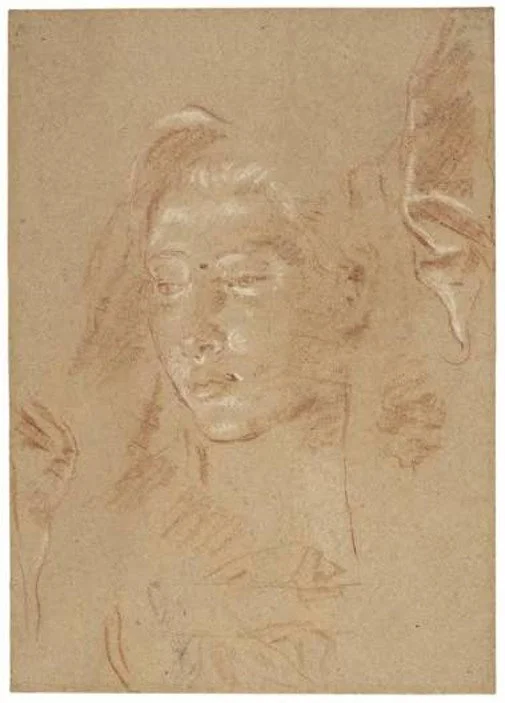
GIOVANNI BATTISTA TIEPOLO (Venice 1696-1770 Madrid)
Study of a female head and of drapery,
Red and white chalk, on light brown (formerly blue) paper,
91⁄8 x 61⁄2 in.