
Overstone Spotlight
Victoria Kleiner: Head of Art
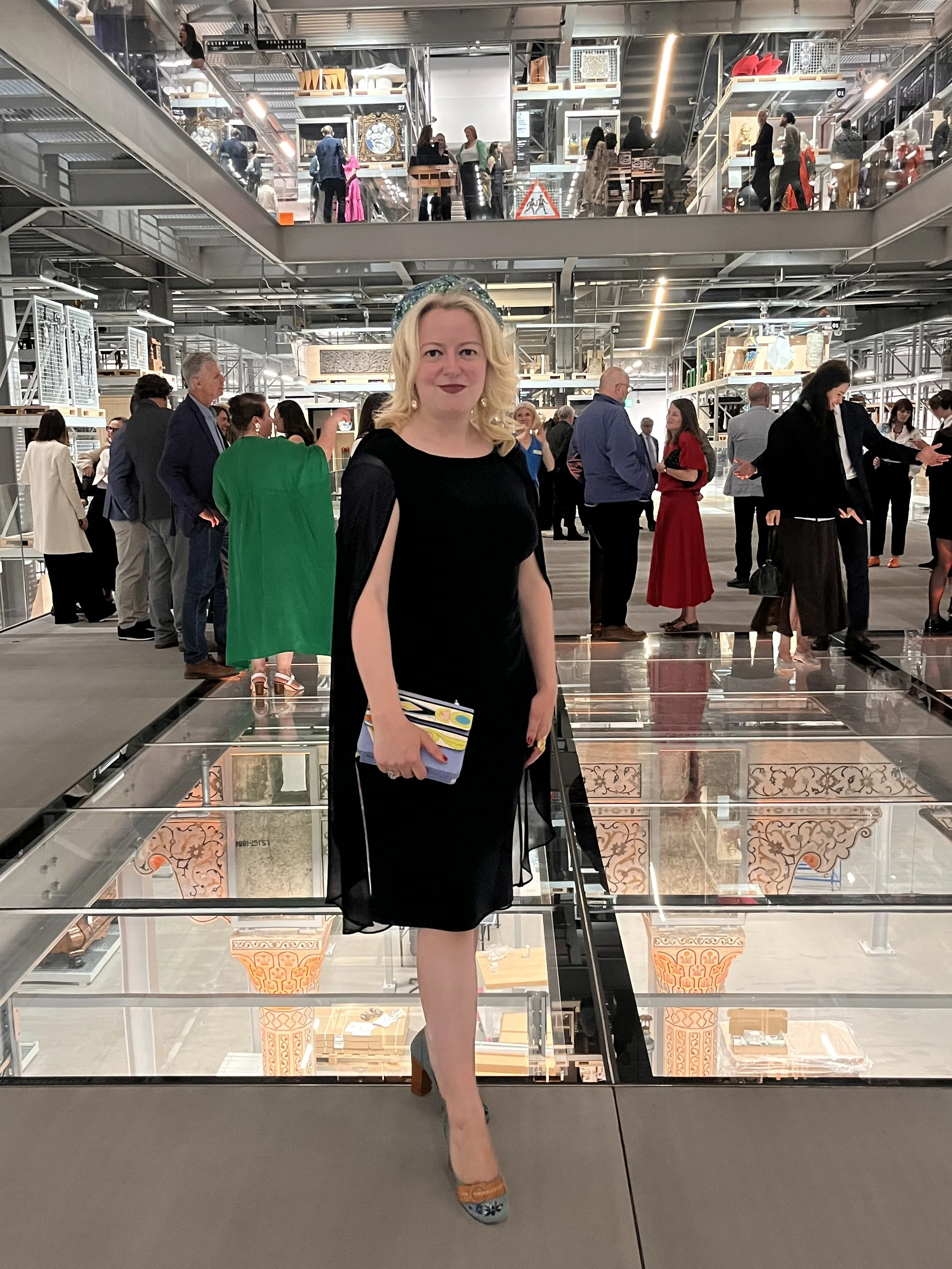
Could you tell us about your professional journey and what has shaped your career and decisions? What aspects of your work continue to inspire and motivate you on a daily basis?The common thread throughout my career is the value we place on ideas, creativity and our culture.
My professional journey started off at Sotheby’s, where I worked for several years as part of the Specialist teams in the Contemporary and Impressionist and Modern Art Departments.
It was an incredibly fast-paced role, and our teams would examine hundreds of artworks each year when preparing for the auctions. As such, it was the best possible place to develop a high-level knowledge of the commercial art market, as well as building up extensive subject-matter expertise.
I then worked at MacDougall’s, a London based auction house specialising in Russian Art, as Senior Specialist and Acting Company Head.
I joined Overstone in 2020, where I head the Art side of the company. The role is wonderfully diverse and varied, overseeing thousands of art valuations a year and carrying out extensive research and due diligence on artworks.
You never know what amazing artwork you will be analysing next – it could be a rare Veronese and a cutting-edge Contemporary artwork in the same hour.
In recent discussions, there has been debate about whether AI could replace the traditional role of the art connoisseur, particularly in attribution. From your professional perspective, to what extent can AI reliably support, or even substitute, human expertise in this area?
Whilst AI has much to offer in this field, as in every other, attribution is a particularly complex exercise, especially in the case of Old Master works.
Given the frequency with which Old Master artist attributions can change as new information comes to light, or as expertise passes down the generations, it would be extremely difficult to ensure that an AI agent could be fed the correct data on which to learn.
In addition, with art connoisseurship comes an accompanying instinctive ‘gut’ feeling when looking at a genuine painting, which relies on an arguably indefinable human element that AI is currently unable to re-create.
Overstone relies on the combination of expert knowledge and AI tools. From your perspective, what are the main advantages of using AI in our field, and why is it essential to complement AI analysis with human expertise?
AI allows us to work with, and analyse, vast data sets in the most efficient and speedy manner. Although valuation of artworks using AI is still in its infancy, the speed with which appropriate auction comparables can be gathered and utilised to produce a result far exceeds that of a human specialist.
However, as touched on in the previous question, human expertise relies on deep instinct supported by knowledge and experience to assess how commercial a work is, and how well it will perform at auction.
The creation of an artwork is not logical, relying instead on emotions and feelings – and, in turn, conveying emotions and feelings – in a way that a data focussed AI is not yet able to comprehend.
...and finally, if any artwork could hang on your wall, which one would you choose and why?
Kandinsky’s ‘Composition VII’ from 1913 is a true visual feast, composed of swirling colours and abstract forms.
It was painted as Kandinsky increasingly pushed the boundaries between representational and abstract art, and features a fascinating array of symbolism in terms of the forms and colours used.
We are now so used to seeing abstract artworks that it easy to forget how groundbreaking Kandinsky was at the time, being a true artistic pioneer.